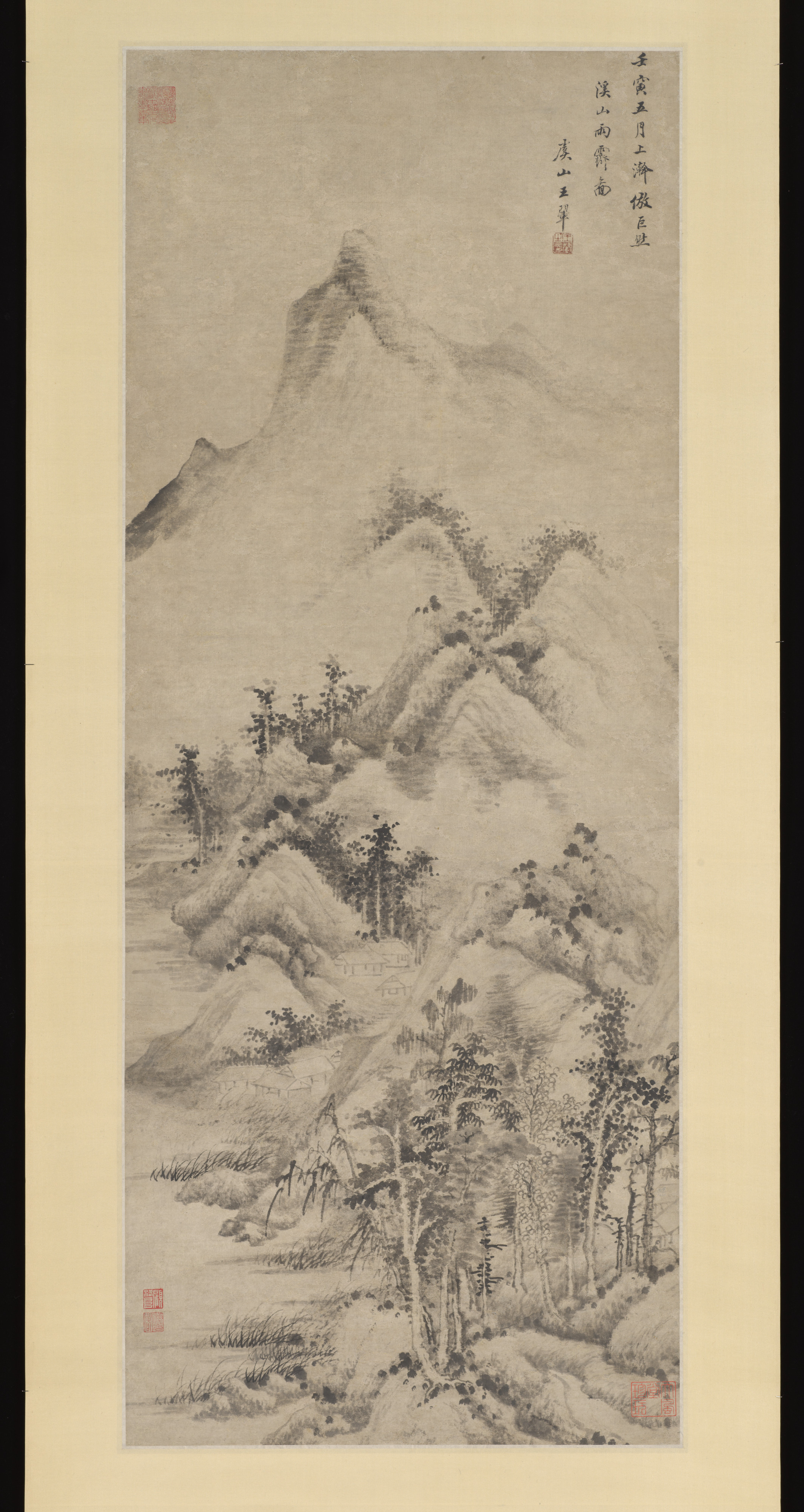
A world within a landscape
In Qian Xuan’s painted world, a familiar act of looking opens onto something much larger.
Qian Xuan, Wang Xizhi Watching Geese (detail), c. 1295. The Metropolitan Museum of Art ↗
Begin with the water
Before trying to name everything in a landscape, let your eye wander. Follow the bank, pause at an empty stretch of water, then move towards the trees. A painted landscape offers a route for the eye rather than a single fixed viewpoint.
The Metropolitan Museum of Art identifies this work as Wang Xizhi watching geese, by Qian Xuan. The title brings a celebrated calligrapher into a landscape. Look for the small human presence, then consider how much of the picture is given over to the world around him.
An unfolding encounter
At screen size, details compete for attention. Open the full image and take your time with the relation between the figures and their setting. The rhythm of the banks, trees and open spaces can guide a second, slower reading.
This is a visual interpretation, not a reconstruction of an observed event. The museum’s object record, linked below, provides the catalogue attribution, dating and material information. Keeping that record beside our own looking lets us distinguish what is documented from what we see and imagine.
Look again
Try returning to the image after reading its title. Has the scene changed? A story can direct our attention, but a painting always has more to offer than the first thing we notice.
Sources & further reading
About this image+
- Image attribution
- Qian Xuan, Wang Xizhi Watching Geese, c. 1295 (detail). The Metropolitan Museum of Art, Ex coll.: C. C. Wang Family, Gift of The Dillon Fund, 1973. 1973.120.6. Public Domain / CC0.
- License
- CC0 ↗
- Source
- The Metropolitan Museum of Art ↗